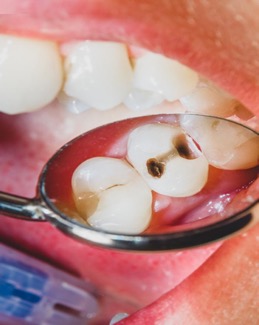
What is tooth decay?
Decay is the progressive destruction of the mineralised tissues of the tooth by acids produced by certain bacteria in dental plaque.
It usually starts in the enamel and may then progress into the dentine.
At an early stage, a cavity can be completely painless. As it progresses, it may cause sensitivity or pain and eventually reach the pulp at the centre of the tooth.
This is why a cavity should not be assessed on pain alone.
What are the symptoms of a cavity?
A cavity may notably present as:
- sensitivity to cold or heat;
- sensitivity to sugar;
- pain during or after meals;
- pain when chewing;
- a visible cavity in a tooth;
- an unusual discolouration;
- a piece of tooth breaking off;
- an old filling or composite falling out;
- food regularly getting stuck between two teeth.
However, a cavity may also be present with no symptoms at all.
A clinical examination, completed where necessary by an X-ray, allows its extent to be assessed.
How is a cavity treated?
Not all cavities are treated in the same way.
The choice between a composite, a ceramic inlay/onlay or a crown mainly depends on the extent of the cavity, the amount of healthy tooth tissue remaining and the strength of the remaining walls of the tooth.
Cavity limited to the occlusal surface: composite restoration
When the cavity remains limited to the occlusal surface — the chewing surface — and the walls of the tooth are intact, it can be restored directly at the practice with a tooth-coloured composite resin. This is a regulated procedure (acte conventionné), covered by French health insurance according to the applicable fee schedule.
This indication remains limited. As soon as the cavity extends to one or more lateral surfaces of the tooth, a direct composite restoration offers lower mechanical strength and a less durable seal over time. The practice then favours an indirect ceramic restoration.
Cavity extending to several surfaces: the ceramic inlay-onlay
As soon as the cavity extends to one or more lateral surfaces of the tooth, a ceramic inlay or onlay is the usual indication at the practice: it is not a fallback after a failed composite, but the treatment favoured from the outset in this situation.
The aim is to rebuild the destroyed part of the tooth precisely and, where necessary, to protect cusps that have become fragile.
At Dr Gary Murciano's practice, inlays and onlays are made of ceramic.
Fees for a ceramic inlay or onlay are generally between 500 and 700 € at the practice.
A detailed quote setting out the fees and coverage arrangements is provided before treatment.
Why not simply place a very large composite?
When only a small amount of tooth tissue has been destroyed, a composite is a suitable conservative option.
The situation is different when the cavity extends and several walls of the tooth are involved.
The greater the amount of tooth to be rebuilt, the more the restoration is subject to chewing forces.
Some walls or cusps may also become thin and fragile.
In these situations, rather than rebuilding an extensive loss of structure with a direct composite alone, we generally favour a custom-made ceramic restoration when it is appropriately indicated.
The aim is to restore the tooth while preserving as much of the remaining healthy dental tissue as possible.
What is a ceramic inlay/onlay?
An inlay or onlay is a custom-made ceramic piece that replaces the part of the tooth that has been destroyed.
Unlike a composite placed directly in the mouth, it is an indirect restoration.
After the decay has been removed and the tooth prepared, an impression reproduces its shape precisely.
The ceramic restoration is then bonded to the tooth following an adhesive protocol.
What is the difference between an inlay and an onlay?
An inlay mainly restores a cavity inside the tooth without covering the cusps.
An onlay can also cover one or more cusps when they need to be protected or rebuilt.
The choice depends on the amount and location of the dental tissue remaining once the decay has been removed.
Composite, inlay-onlay or crown: how to choose?
Cavity limited to the occlusal surface, walls intact
→
Composite
regulated procedure
Cavity extending to one or more lateral surfaces
→
Ceramic inlay or onlay
500 to 700 €
Severely broken-down tooth or insufficiently strong walls
→
Crown
500 to 800 €
This presentation is deliberately simplified. The treatment decision is made case by case after clinical and, where necessary, radiographic examination.
Can an inlay/onlay avoid a crown?
Yes, in some situations.
When a tooth has lost too much structure for us to favour a direct composite but still has enough healthy tissue, an inlay or onlay may restore the tooth without necessarily resorting to a full crown.
A crown covers the tooth far more extensively, whereas an inlay/onlay is a partial restoration that replaces or protects only the parts that require it.
When clinical conditions allow, this approach therefore preserves more natural tooth tissue.
Conversely, when a tooth is too badly broken down or the remaining tissue does not allow a sufficiently reliable partial restoration, a crown may be necessary.
What happens if the cavity is very deep?
A large cavity does not automatically mean the tooth must have root canal treatment.
Whenever possible, the aim is to keep the tooth vital.
However, when a cavity becomes very deep, it may reach or cause irreversible inflammation of the pulp at the centre of the tooth.
Significant spontaneous pain, night pain or prolonged sensitivity to heat or cold may in particular lead us to look for pulp involvement.
A clinical and radiographic examination then establishes the diagnosis.
When endodontic treatment — commonly called root canal treatment — is necessary, the tooth must then be restored in a way suited to the amount of remaining tissue.
Endodontic treatments are carried out at the practice by Dr Gary Murciano.
My filling or composite has fallen out: what should I do?
Losing an old restoration warrants a check-up, even if the tooth does not hurt.
Several situations are possible: the old restoration may simply have debonded or fractured, new decay may have developed, or part of the tooth itself may have broken.
Treatment will then depend on the amount of remaining tooth tissue.
For a small cavity, a composite may be indicated.
When more tooth structure has been lost, a ceramic inlay/onlay may be considered.
In case of pain or a lost restoration, an appointment is offered within 24 to 48 hours subject to the practice's availability.
It is best not to wait for pain to appear or worsen before consulting.
I have broken a piece of a molar: does it necessarily mean a crown?
Not necessarily.
When a piece of a premolar or molar fractures, whether the tooth can be kept depends on the size and location of the fracture.
In some situations, a partial ceramic onlay restoration can rebuild the fractured part and protect the tooth without covering it entirely with a crown.
In other situations, a crown or another treatment may be necessary.
Only examining the tooth can determine this.
Can a cavity be extensive without hurting?
Yes.
Pain is not directly proportional to the size of the cavity.
A lesion can progress gradually without causing any obvious symptom.
A tooth may therefore have lost a substantial amount of structure while the patient feels almost nothing.
This is one reason why regular check-ups and, when indicated, X-rays make it possible to detect some lesions before symptoms appear.
What is the risk of waiting with a cavity?
An established carious cavity does not rebuild itself.
If the decay continues to progress, an increasing amount of tooth tissue may be destroyed.
A small lesion initially requiring a limited restoration may thus evolve into a loss of structure requiring a more extensive restoration.
If it progresses as far as the pulp, endodontic treatment may also become necessary.
The earlier a cavity is treated, the more it is generally possible to preserve dental tissue.